Tuesday, June 25, 2013

Google Grants Cannabis Group $240,000 in AdWords Money & Other Products

Google's got $5 on it ... er, make that $240,000. This is according to last week's announcement from a medical cannabis nonprofit.

According to Michigan Compassion, Google awarded the group $240,000 annually in AdWords advertising through Google Grants as well as the use of other Google products for nonprofits.

If you're unfamiliar with Google Grants, it's the nonprofit version of AdWords launched in 2003, which allows participating nonprofits to spend up to $10,000 per month in grants on AdWords.

The grant for Michigan Compassion advertising doesn't seem to fit neatly within any of Google's AdWords policies. According to its guidelines, there are certain restrictions on prescription drugs and even tobacco, but since Michigan Compassion is not a direct retailer for prescription marijuana, rather an organization dedicated to the awareness of the benefits of medical cannabis, the guidelines could be different.

It looks as though an organization like this could be given the same allowances that say, vaporizers are in AdWords. While Google does not allow the direct sale of drug paraphernalia, it does allow the sale of vaporizers "when promoted as a humidifier or as an aromatherapy device to relieve respiratory symptoms."
drug-paraphernalia-adwords We reached out to Google for some clarification on the grant and any restrictions that ads from Michigan Compassion might have; we were curious about a few things:
  • Will ads from Michigan Compassion be assigned a family status or non-family status?
  • Will ads be targeted only to Michigan or also to other states allowing medical marijuana?
  • How does Google distinguish between the promotion of tobacco versus promotion of cannabis in AdWords?
A Google spokesperson had this to say about the Michigan Compassion AdWords grant:

"Our regular Grants program was approved for this organization as a certified 501(3)(c) non-profit to run ads that comply with our policies. Specifically, their ads are designated as non-family safe, are approved in states where medical marijuana is legal in the U.S., and they are not permitted to sell the product or paraphernalia on their site."

Google Rolls Out AdWords Dynamic Retargeting For Retailers

In another move to beef up its retargeting offerings–and take on retargeting platforms like Adroll, Retargeter and Mediaforge–Google is rolling out dynamic retargeting to all AdWords retail customers with Google Merchant Feeds. The company is also piloting dynamic retargeting in the travel and education sectors and plans to expand availability to more sectors later this year.

With dynamic retargeting ads are created on the fly with product images pulled from your Google Merchant feed. Google’s product recommendation engine determines which products and messages are shown based on an algorithmic prediction for what is likely to perform best based on visitors’ past actions on your site, including the products they viewed and their purchase history, as well as related products and top performing products.

For example, if a person is shopping for pots and pans, the product recommendation engine may populate the ad with the pot set they last viewed, other top selling pot sets, and kitchen utensils and small appliances.

There are multiple templates that you can customize to reflect the design elements of your brand. Layouts are optimized automatically for each ad impression.

In pilot tests, Google says that Sierra Trading Post, a U.S. retailer of outdoor gear and clothing, saw click through rate double and conversion rate increase by 5x. European “heavy metal online shop,” EMP Merchandising’s conversion rates rose by 230% and the cost of sale fell by 30%.

In the ModCloth template, the ad shows a recently viewed dress with price details along with other related products.

When setting up a dynamic retargeting campaign, in addition to the “All visitors” list, Google automatically creates four lists that reflect four groups of site visitors:

    General visitors - People who visited your website but didn’t view specific product. The dynamic ad will include the most popular products from your site.

    Product viewers - People who viewed specific product pages on your site but did not add them to the shopping cart. The dynamic ad will show the products that your visitors viewed and mix in recommended products.

    Shopping cart abandoners - People who added products to the shopping cart but didn’t complete the purchase. The dynamic ad will prioritize items added into the shopping cart, and will mix in a few other viewed products and recommended products.

    Past buyers - People who purchased products from you in the past. The dynamic ad will show related products by looking at popular items and items commonly purchased together.

To get started, you’ll can edit your existing remarketing tag if you are using one already, or you’ll need to add the dynamic remarketing tag AdWords generates for your site across all your site pages along with several custom parameters.

When people visit your site, the remarketing tag adds them to one of the remarketing list and associates the product ID with the visit. AdWords then uses the product ID to pull the product image, name, and price from your Google Merchant Center account and include in the ad. You can add additional parameters to the tag to for more advanced bidding and optimization control.

Wednesday, June 19, 2013

Google Officially Launches Knowledge Graph Carousel For Local Search

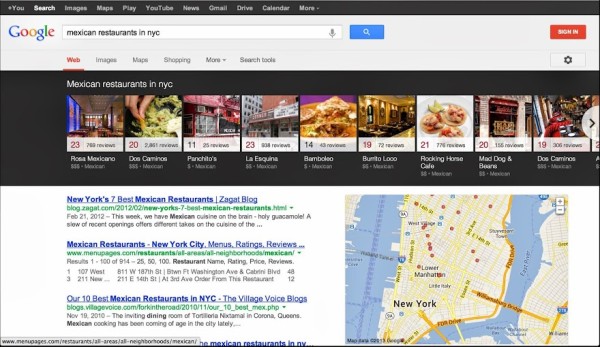
After reporting yesterday that the Google Knowledge Graph Carousel was showing up more frequently and for a wider variety of searches, a Google+ post today announced the official launch of Carousel for local search results.

According to the announcement, when a user searches for “restaurants, bars or other local places” from their desktop, they will get the horizontal Carousel display of images against a black background at the top of their SERP.
Caroursel Display
Users can scroll through more images by selecting the arrow on the right side of the carousel or zoom in on the map to pull results for a restricted area. By clicking on an image in the Carousel, users will see more location details, including overall review-based score, address and photos.
Google Knowledge Graph Carousel display
Google confirmed that Carousel results are rolling out today in English in the US, with more features and languages to come over time.

Google, Bing Both Win More Search Market Share

Google Bing Yahoo logos
Another month and another new release of comScore search engine rankings for the U.S. for May 2013. Google and Bing are both up, while the other top search engines comScore tracks (Yahoo, Ask, AOL) were flat or saw declines.

Not surprisingly, Google led the way for search share in May, and grew its search market share to 66.7 percent, up from 66.5 percent in April. Google has the identical search share of 66.7 percent when comparing May 2012 and May 2013.

Bing grew to 17.4 percent in May, up from 17.3 percent in April. This is a significant increase from its 15.4 percent search market share in May 2012.

Meanwhile, Yahoo dropped slightly from 12 percent in April to 11.9 percent in May. Yahoo is down considerably from May 2012, when it had a 13.4 percent search market share.

This continues the trend of Microsoft’s Bing and Yahoo simply swapping search share rather than making inroads on Google’s massive search share.

Ask held steady at 2.7 percent from April to May, but AOL's search market share fell to 1.3 percent, down from 1.5 percent. AOL's search market share has only been this low one other time, when it previously hit this record low in August 2011.

When looking at the 20 billion search queries conducted in May specifically, Google remained static with 13.4 billion, while again Microsoft gained 1 percent to 3.5 billion searches, while Yahoo lost 1 percent to 2.4 billion. Interestingly, AOL lost 8 percent of search queries over the previous month.

Monday, June 17, 2013

Google Webmaster Tools Warnings to Include Example URLs

Good news for webmasters who have been struggling to identify links and pages that have been trigger warnings in Google Webmaster Tools. Google will now include example URLs in their emails warning webmasters about manual spam actions.

There are many cases where webmasters know they have manual web spam action taken against their site, but they can't figure out what is triggering the spam action, or they are confused and believe the wrong thing has caused the manual spam action.

In a Webmaster Help video, Google's Matt Cutts details the types of cases where people are struggling to identify problems on their site, part of how Google Webmaster Tools is trying to provide more concrete actionable information in their emails to webmasters.
"For example, we've seen a couple sites that had millions of pages that had manual web spam action taken on just a very small number of pages, or in one case, just one page. But they got a message saying 'Hey you need to look out because some of your content have been defaced', and they didn't know exactly where to look."

Don't think Google will hold your hand and include every single thing that is wrong with your website, but getting a couple very specific URLs to show what is wrong with your site, which you can then use to help identify other pages with the same issue, definitely helps take some of the guess work out of the cleanup equation.

"Now we won't be able to show every single thing that we think is wrong for a couple reasons," Cutts said. "Number one, it might help the spammers. Number two, if there are a lot of bad pages, we could be sending out emails that are 50 MB long. But we do think that it's helpful if we can include a small number of example URLs that will help you as a webmasters know whenever you try to fix things and clean the site back up.

"It's much better than I was a few months ago and we'll really looking for ways to provide even more guidance and a little more transparency so webmasters get a better idea where to look," Cutts said. "It's going to take some time to rollout and test and ramp up and there might be a few cases where people might not be able to get an example but for the most part we are going to try to provide more and more information over time so that legitimate webmasters can know where they need to look to try to fix problems."

"Stock Images Do Not Impact Search Engine Rankings" says Matt Cutts

Google’s head of search spam, Matt Cutts, said in a recent video that using stock images from a stock image website has no impact on rankings.

The question was, “Does using stock photos on your pages have a negative effect on rankings?”

Matt’s answer was very short, he said “no.” There is no positive or negative impact on your organic Web ranking if you use stock imagery versus original imagery.

Of course, if you want to go deeper, images might enhance your content, which may attract more visitors and more links. But, images are currently not a ranking factor for your content, according to Matt Cutts.

Another obvious point is that this is not discussing image search ranking. Typically, you won’t see the same image shown in the image search results. So, having unique images may help there.

Here is the video from Matt:


Wednesday, June 12, 2013

Google’s Cutts Talks Structured Data Beta, Mobile Site Speed Need, Penalty Notices To Get Example Links & More


Last night at SMX Advanced, Google’s head of search spam, Matt Cutts was on stage to answer questions about Google search and webmaster topics with Danny Sullivan. We covered the session in live blog format and pulled out several key points.
smx-cutts-sullivan
Of all my years watching Matt Cutts talk, I believe it has been over ten years now, I have never seen Matt reveal so much new information and announce so many new things in a single hour at a conference.

Here are the highlights from last night, with links to those individual stories:

  • Google Payday Loan Algorithm: Google Search Algorithm Update To Target Spammy Queries – Google launched a new algorithm that is currently rolling out to target more spammy industries and some of the “illegal” SEO and linking tactics they use.
  • Google’s Panda Dance: Matt Cutts Confirms Panda Rolls Out Monthly Over 10 Of 30 Days – Similar to the Google Dance, which was how Google pushed out new indexes in the early 2000s, Panda updates are typically pushed out monthly and run over a 10 day period.
  • Google Webmaster Notifications Now To Show Example URLs – Matt promises that most, if not all, manual penalty notification emails from Webmaster Tools will include a few examples of the problem so webmasters can better understand what to look for to fix their issues.
  • Google: Site Speed Penalty Coming To Mobile Web Sites – In addition to the mobile SEO demotions Google announced yesterday morning, Google will also add a ranking factor to mobile search results based on the site speed time of your mobile web pages. I have to assume that speed is a larger factor on mobile than desktop, but that speed time was not disclosed.
  • Google Structured Data Dashboard Beta – Want to test out a new dashboard in Google Webmaster Tools to see errors and reporting on your webpage’s structured data? You can sign up for the beta over here.
Finally, here is the full hour video of the chat with Matt Cutts and Danny Sullivan.