Tuesday, June 25, 2013

AdWords “Remarketing Lists For Search Ads” Coming Out Of Beta

google-adwords-square-logo 
On the heels of releasing dynamic retargeting for retailers in AdWords, Google has announced it will be rolling out remarketing lists for search ads (RLSA) to all enhanced campaigns advertisers over the next few days. RLSA, which launched in beta last July, allows marketers to modify and tailor their search ads, bids, and keywords based on visitors’ past activity on their sites.

In the beta, a European online tire retailer saw a 161 percent conversion rate increase with RLSA, which led to a 22 percent overall sales increase. The new conversions had a 43 percent lower average CPA than previous campaigns, according to Google.

Using RLSA, you can increase bids for past site visitors who looked at specific high-value pages, added items to their carts or spent a certain amount of time on your site. You can also bid on more generic keywords, or broader match types of keywords for site visitors or past customers that you don’t include in your regular campaigns because they are too broad for general search traffic.

You can then show different ads to specific sets of site visitors. For example, you can write ad copy targeted to shopping cart abandoners.

RLSA bid adjustments combine with other bid adjustments for location, device and time in enhanced campaigns.

To use RLSA, you’ll need to tag your site with the Google Remarketing Tag for the Google Display Network. So if your site is already set with the remarketing tag, you are ready to start running RLSA.

Google Update Underway: But For Payday Or Panda?


payday-panda 
There appears to be an update underway, one that will be rolling out over a “multi-week” timeframe according to Google’s head of search spam, Matt Cutts.

The update was announced by Matt on Twitter in response to a question about why some of the search results look spammy. Matt replied saying, “Yup we saw that. Multi-week rollout going on now, from next week all the way to the week after July 4th.”

It is unclear exactly what this is an update for. Is it in response to an update on the PayDay algorithm or maybe the softer Panda update? We asked Matt Cutts and Google to clarify but Google won’t clarify.

Google has said that Panda is a multiday update, so maybe this update is related to that. If that is true, we’d probably be at the 27th update to Panda. The last Panda update we counted was Panda 25 but Google stopped announcing them; however, we think there has been at least one Panda refresh since the last confirmed update.

Or, this update Matt is referring to may be designed to improve the situation with the PayDay loans algorithm having some oddities. Such as the example Matt responded to with a search for [car insurance] in Google UK and the Matt Cutts payday loan hack from a week ago. There are many examples of places where the payday loan algorithm did not remove spam, so this update might be related to that.

Have you noticed ranking and traffic changes from Google over the past few days? Let us know in the comments.

Google Grants Cannabis Group $240,000 in AdWords Money & Other Products

Google's got $5 on it ... er, make that $240,000. This is according to last week's announcement from a medical cannabis nonprofit.

According to Michigan Compassion, Google awarded the group $240,000 annually in AdWords advertising through Google Grants as well as the use of other Google products for nonprofits.

If you're unfamiliar with Google Grants, it's the nonprofit version of AdWords launched in 2003, which allows participating nonprofits to spend up to $10,000 per month in grants on AdWords.

The grant for Michigan Compassion advertising doesn't seem to fit neatly within any of Google's AdWords policies. According to its guidelines, there are certain restrictions on prescription drugs and even tobacco, but since Michigan Compassion is not a direct retailer for prescription marijuana, rather an organization dedicated to the awareness of the benefits of medical cannabis, the guidelines could be different.

It looks as though an organization like this could be given the same allowances that say, vaporizers are in AdWords. While Google does not allow the direct sale of drug paraphernalia, it does allow the sale of vaporizers "when promoted as a humidifier or as an aromatherapy device to relieve respiratory symptoms."
drug-paraphernalia-adwords We reached out to Google for some clarification on the grant and any restrictions that ads from Michigan Compassion might have; we were curious about a few things:
  • Will ads from Michigan Compassion be assigned a family status or non-family status?
  • Will ads be targeted only to Michigan or also to other states allowing medical marijuana?
  • How does Google distinguish between the promotion of tobacco versus promotion of cannabis in AdWords?
A Google spokesperson had this to say about the Michigan Compassion AdWords grant:

"Our regular Grants program was approved for this organization as a certified 501(3)(c) non-profit to run ads that comply with our policies. Specifically, their ads are designated as non-family safe, are approved in states where medical marijuana is legal in the U.S., and they are not permitted to sell the product or paraphernalia on their site."

Google Rolls Out AdWords Dynamic Retargeting For Retailers

In another move to beef up its retargeting offerings–and take on retargeting platforms like Adroll, Retargeter and Mediaforge–Google is rolling out dynamic retargeting to all AdWords retail customers with Google Merchant Feeds. The company is also piloting dynamic retargeting in the travel and education sectors and plans to expand availability to more sectors later this year.

With dynamic retargeting ads are created on the fly with product images pulled from your Google Merchant feed. Google’s product recommendation engine determines which products and messages are shown based on an algorithmic prediction for what is likely to perform best based on visitors’ past actions on your site, including the products they viewed and their purchase history, as well as related products and top performing products.

For example, if a person is shopping for pots and pans, the product recommendation engine may populate the ad with the pot set they last viewed, other top selling pot sets, and kitchen utensils and small appliances.

There are multiple templates that you can customize to reflect the design elements of your brand. Layouts are optimized automatically for each ad impression.

In pilot tests, Google says that Sierra Trading Post, a U.S. retailer of outdoor gear and clothing, saw click through rate double and conversion rate increase by 5x. European “heavy metal online shop,” EMP Merchandising’s conversion rates rose by 230% and the cost of sale fell by 30%.

In the ModCloth template, the ad shows a recently viewed dress with price details along with other related products.

When setting up a dynamic retargeting campaign, in addition to the “All visitors” list, Google automatically creates four lists that reflect four groups of site visitors:

    General visitors - People who visited your website but didn’t view specific product. The dynamic ad will include the most popular products from your site.

    Product viewers - People who viewed specific product pages on your site but did not add them to the shopping cart. The dynamic ad will show the products that your visitors viewed and mix in recommended products.

    Shopping cart abandoners - People who added products to the shopping cart but didn’t complete the purchase. The dynamic ad will prioritize items added into the shopping cart, and will mix in a few other viewed products and recommended products.

    Past buyers - People who purchased products from you in the past. The dynamic ad will show related products by looking at popular items and items commonly purchased together.

To get started, you’ll can edit your existing remarketing tag if you are using one already, or you’ll need to add the dynamic remarketing tag AdWords generates for your site across all your site pages along with several custom parameters.

When people visit your site, the remarketing tag adds them to one of the remarketing list and associates the product ID with the visit. AdWords then uses the product ID to pull the product image, name, and price from your Google Merchant Center account and include in the ad. You can add additional parameters to the tag to for more advanced bidding and optimization control.

Wednesday, June 19, 2013

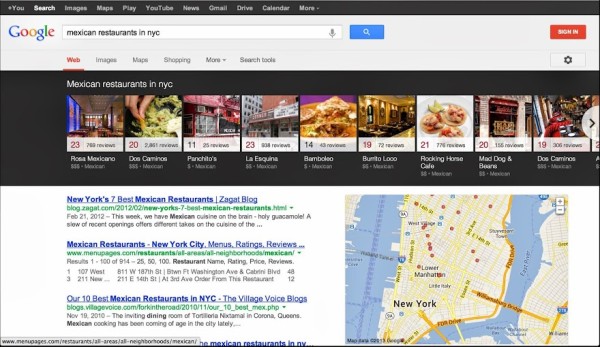
Google Officially Launches Knowledge Graph Carousel For Local Search

After reporting yesterday that the Google Knowledge Graph Carousel was showing up more frequently and for a wider variety of searches, a Google+ post today announced the official launch of Carousel for local search results.

According to the announcement, when a user searches for “restaurants, bars or other local places” from their desktop, they will get the horizontal Carousel display of images against a black background at the top of their SERP.
Caroursel Display
Users can scroll through more images by selecting the arrow on the right side of the carousel or zoom in on the map to pull results for a restricted area. By clicking on an image in the Carousel, users will see more location details, including overall review-based score, address and photos.
Google Knowledge Graph Carousel display
Google confirmed that Carousel results are rolling out today in English in the US, with more features and languages to come over time.

Google, Bing Both Win More Search Market Share

Google Bing Yahoo logos
Another month and another new release of comScore search engine rankings for the U.S. for May 2013. Google and Bing are both up, while the other top search engines comScore tracks (Yahoo, Ask, AOL) were flat or saw declines.

Not surprisingly, Google led the way for search share in May, and grew its search market share to 66.7 percent, up from 66.5 percent in April. Google has the identical search share of 66.7 percent when comparing May 2012 and May 2013.

Bing grew to 17.4 percent in May, up from 17.3 percent in April. This is a significant increase from its 15.4 percent search market share in May 2012.

Meanwhile, Yahoo dropped slightly from 12 percent in April to 11.9 percent in May. Yahoo is down considerably from May 2012, when it had a 13.4 percent search market share.

This continues the trend of Microsoft’s Bing and Yahoo simply swapping search share rather than making inroads on Google’s massive search share.

Ask held steady at 2.7 percent from April to May, but AOL's search market share fell to 1.3 percent, down from 1.5 percent. AOL's search market share has only been this low one other time, when it previously hit this record low in August 2011.

When looking at the 20 billion search queries conducted in May specifically, Google remained static with 13.4 billion, while again Microsoft gained 1 percent to 3.5 billion searches, while Yahoo lost 1 percent to 2.4 billion. Interestingly, AOL lost 8 percent of search queries over the previous month.

Monday, June 17, 2013

Google Webmaster Tools Warnings to Include Example URLs

Good news for webmasters who have been struggling to identify links and pages that have been trigger warnings in Google Webmaster Tools. Google will now include example URLs in their emails warning webmasters about manual spam actions.

There are many cases where webmasters know they have manual web spam action taken against their site, but they can't figure out what is triggering the spam action, or they are confused and believe the wrong thing has caused the manual spam action.

In a Webmaster Help video, Google's Matt Cutts details the types of cases where people are struggling to identify problems on their site, part of how Google Webmaster Tools is trying to provide more concrete actionable information in their emails to webmasters.
"For example, we've seen a couple sites that had millions of pages that had manual web spam action taken on just a very small number of pages, or in one case, just one page. But they got a message saying 'Hey you need to look out because some of your content have been defaced', and they didn't know exactly where to look."

Don't think Google will hold your hand and include every single thing that is wrong with your website, but getting a couple very specific URLs to show what is wrong with your site, which you can then use to help identify other pages with the same issue, definitely helps take some of the guess work out of the cleanup equation.

"Now we won't be able to show every single thing that we think is wrong for a couple reasons," Cutts said. "Number one, it might help the spammers. Number two, if there are a lot of bad pages, we could be sending out emails that are 50 MB long. But we do think that it's helpful if we can include a small number of example URLs that will help you as a webmasters know whenever you try to fix things and clean the site back up.

"It's much better than I was a few months ago and we'll really looking for ways to provide even more guidance and a little more transparency so webmasters get a better idea where to look," Cutts said. "It's going to take some time to rollout and test and ramp up and there might be a few cases where people might not be able to get an example but for the most part we are going to try to provide more and more information over time so that legitimate webmasters can know where they need to look to try to fix problems."

"Stock Images Do Not Impact Search Engine Rankings" says Matt Cutts

Google’s head of search spam, Matt Cutts, said in a recent video that using stock images from a stock image website has no impact on rankings.

The question was, “Does using stock photos on your pages have a negative effect on rankings?”

Matt’s answer was very short, he said “no.” There is no positive or negative impact on your organic Web ranking if you use stock imagery versus original imagery.

Of course, if you want to go deeper, images might enhance your content, which may attract more visitors and more links. But, images are currently not a ranking factor for your content, according to Matt Cutts.

Another obvious point is that this is not discussing image search ranking. Typically, you won’t see the same image shown in the image search results. So, having unique images may help there.

Here is the video from Matt:


Wednesday, June 12, 2013

Google’s Cutts Talks Structured Data Beta, Mobile Site Speed Need, Penalty Notices To Get Example Links & More


Last night at SMX Advanced, Google’s head of search spam, Matt Cutts was on stage to answer questions about Google search and webmaster topics with Danny Sullivan. We covered the session in live blog format and pulled out several key points.
smx-cutts-sullivan
Of all my years watching Matt Cutts talk, I believe it has been over ten years now, I have never seen Matt reveal so much new information and announce so many new things in a single hour at a conference.

Here are the highlights from last night, with links to those individual stories:

  • Google Payday Loan Algorithm: Google Search Algorithm Update To Target Spammy Queries – Google launched a new algorithm that is currently rolling out to target more spammy industries and some of the “illegal” SEO and linking tactics they use.
  • Google’s Panda Dance: Matt Cutts Confirms Panda Rolls Out Monthly Over 10 Of 30 Days – Similar to the Google Dance, which was how Google pushed out new indexes in the early 2000s, Panda updates are typically pushed out monthly and run over a 10 day period.
  • Google Webmaster Notifications Now To Show Example URLs – Matt promises that most, if not all, manual penalty notification emails from Webmaster Tools will include a few examples of the problem so webmasters can better understand what to look for to fix their issues.
  • Google: Site Speed Penalty Coming To Mobile Web Sites – In addition to the mobile SEO demotions Google announced yesterday morning, Google will also add a ranking factor to mobile search results based on the site speed time of your mobile web pages. I have to assume that speed is a larger factor on mobile than desktop, but that speed time was not disclosed.
  • Google Structured Data Dashboard Beta – Want to test out a new dashboard in Google Webmaster Tools to see errors and reporting on your webpage’s structured data? You can sign up for the beta over here.
Finally, here is the full hour video of the chat with Matt Cutts and Danny Sullivan.

Google Targets Spammy Queries, Bad Mobile Sites With New Ranking Updates

Google’s Distinguished Engineer Matt Cutts has announced that a new ranking update, one that targets spammy queries is now live. Separately, Google is warning that if you have a bad mobile website, your search rankings will soon be hurting.


payday-loans-google-uk

The ranking update for spammy queries, which will impact 0.3 percent to 0.5 percent of queries in English, shouldn’t come as a surprise to most. This was one of the changes we were told by Cutts to expect from Google this summer. . Cutts specifically mentioned that the change would affect queries such as “payday loans” on Google.co.uk and pornographic queries.

The ranking update is a work in progress, Cutts noted on Twitter, adding that it’s a “a multifaceted rollout that will be happening over the next 1-2 months.”

Smartphone Rankings Changes

google-mobile-search

Bad mobile SEO will cost you. In a post on the Google Webmaster Central Blog, Google warns that “we plan to roll out several ranking changes in the near future that address sites that are misconfigured for smartphone users.”

Google called out two specific areas in their blog post – faulty redirects (“when a desktop page redirects smartphone users to an irrelevant page on the smartphone-optimized website”) and smartphone only errors (when “sites serve content to desktop users accessing a URL but show an error page to smartphone users”).

Google’s advice on properly configuring your mobile site: “Try to test your site on as many different mobile devices and operating systems, or their emulators, as possible.”

In addition, just as site speed has played a part in Google’s web search ranking algorithm since 2010, you can expect site speed to have an impact on the rankings of mobile sites, Cutts announced at the SMX Advanced conference.

Google’s Matt Cutts: Same Ad To Organic Ratio As Google, You’re Safe From The Top-Heavy Alogrithm

At SMX Advanced tonight, Google’s head of search spam, Matt Cutts announced that if you have the same or less ads than Google does in their search results, then you are safe from their top heavy algorithm.

In short, if your ad to organic ratio is the same or less than what you see in Google’s search results, you are safe.

This came up durin the Ask The SEO session, where Matt Cutts was encouraged to come up on stage to answer some questions.

One question was around why does Google have so many ads in the organic result. Danny Sullivan joked, would Google penalize Google for top heavy algorithm? Matt responded seriously that even if the search results pages were indexed by Google, the algorithm that determines if a web page should be penalized or impacted negatively by the top heavy update, would not be triggered.

So you can use Google search results pages as a benchmark for not going overboard on the top heavy update.

Google Search Ranking Changes To Auto-Correct Your Mobile SEO Mistakes

Is your site not doing a good job for mobile visitors? Better get that fixed. Sites with mobile experience issues won’t rank as highly in Google’s mobile or smartphone search results, in the future.
Bad Mobile Site? Fewer Smartphone Search Rankings, For You

Google’s Yoshikiyo Kato and Pierre Far said about the change in a blog post today:

To improve the search experience for smartphone users and address their pain points, we plan to roll out several ranking changes in the near future that address sites that are misconfigured for smartphone users.

They followed by sharing two common mobile configuration mistakes of many and suggested these search ranking changes will help import the smartphone search experience for Google users.
Faulty Redirects

The first issue is called a “faulty” redirect, when a page listed in search may redirect all smartphone users to the same single mobile page, rather than to a mobile-optimized version of the page they’re after:

Credit: Google 

Smartphone-Only Error
The second common mistake is that smartphone users, when trying to access a web page listed in search, get an error and nothing listed.
 
Optimizing For Mobile
Google also says that if you properly configure your mobile friendly pages, it will “improve the mobile web, make your users happy, and allow searchers to experience and experience your content fully.”

Tuesday, June 4, 2013

Google’s Matt Cutts On SEO Industry Misconceptions: Updates, Revenue Goals & Link Building Obsession

Google’s head of search spam, Matt Cutts, released another video today named What are some misconceptions in the SEO industry? In short, Matt outlined three topics in this five-minute video.

(1) SEOs confuse algorithm updates with data refreshes.

(2) Panda & Penguin algorithms are not about making Google more money in the short term.

(3) SEOs spend too much energy and time focused on link building and only thinking about search engines.

Here is the video and my summary will follow:


Algorithm Updates Versus Data Refreshes:

Matt explained that one of the biggest misconceptions he sees in the industry is that SEOs often confuse data refreshes and algorithmic updates. This is a topic we covered before at least once, but in short, here is the difference. An algorithm update is when Google changes the algorithm on how the search results are ranked, indexed or filtered. A data refresh is when Google updates the data where the algorithm runs. For example, we had a Penguin update recently; and, that last update was an algorithm update. There was a change to how the algorithm worked. Prior to that, Penguin 3 and 2 were mostly just data refreshes.
 
Panda & Penguin Updates Are Not About Revenue Gains For Google:

There are many people in the industry that feel Google releases algorithm updates, such as the Panda and Penguin updates with short-term goals of increasing their revenues. Matt said that is absolutely false and the algorithm and organic search results are completely separated from revenue goals.

Matt added that in one of the older earnings report, Panda was listed as a reason why Google’s revenues may not be as high in future quarters. Simply because Panda may have short-term negative impact on Google’s revenues. Why? Because Panda’s goal was to eliminate low-quality content sites that monetized mostly over AdSense revenue.

Then, Matt goes into explaining how Google looks at long-term goals, making the searcher happy, so they come back and search more. Google has methods for letting users take their data and leave. Google is rarely interested in short-term revenue goals, Matt added a few times.

Clearly, this is the PR side of Matt talking; but in my opinion, he 100% believes it.
 
SEOs Focus Too Much On Link Building & Search Engines:

Matt’s final point in the video is discussing what SEOs spend too much energy focusing on. They include link building and search engines, as opposed to their users. Matt said they can spend more time on social media and other areas to help build awareness of their sites.

He then discusses how the history of great sites, those sites generally focus on design and user experience first. This way the user is happy and recommends it to others. Matt added that Craigslist is a great site; but, their user experience is not great. So, there are many startups that come in and beat them on user experience to take over in some niches.

Monday, June 3, 2013

Negative SEO Exists Confirms Google

For years, Google stood by the stance that there was little competitors could do to a website to negatively affect its search engine rankings. As natural links became more valuable and paid links were devalued or penalized, Google changed their stance slightly on the issue, but still maintained it wasn't a widespread issue, with Google's Matt Cutts admitting negative SEO isn't impossible, but it is difficult.

Then came the link disavow tool, which allows webmasters to disallow paid or low quality links and clean up their backlink profile, regardless of whether they or a competitor was responsible for pointing those backlinks at a website.

Now Google has changed their stance once again, simply saying that Google works hard to prevent competitors from utilizing negative SEO.

The change was noticed on the “Can Competitors harm ranking?” help page at Google Webmaster Tools.

When the page first went online, it simply stated “There’s nothing a competitor can do to harm your ranking or have your site removed from our index.” Last year, when negative SEO became a lot more prevalent, the wording was changed to “There's almost nothing a competitor can do to harm your ranking or have your site removed from our index.”

This week, webmasters noticed that the wording was changed once more, to “Google works hard to prevent other webmasters from being able to harm your ranking or have your site removed from our index.”

This is a clear admission that yes, negative SEO does exist and it can result in third parties being able to remove competing sites from the Google search index, or at least negatively impact their search rankings.

While changing the wording is a confirmation for many webmasters that Google is finally acknowledging the problem, it could also tip off negative SEO wars between competitors. Some webmasters might not have engaged in negative SEO for the simple reason that so many people insisted the problem was next to nonexistent, although those who have been impacted by it know otherwise. So some unscrupulous webmasters might think nothing of link bombing competitors with one of those “10,000 backlinks for $20” deals that are advertised everywhere.

That said, webmasters who might not follow SEO news closely, or who haven’t had their sites impacted by negative SEO, might never visit that page and see confirmation that negative SEO is a potential problem. The change to the page reflecting Google’s new stance on the issue was made very quietly, and seems limited to just that single page.

It is a step moving forward that Google is acknowledging that negative SEO is a real problem, but it is also positive that they are also acknowledging that they are looking at ways to combat the issue.