Showing posts with label SEO Consulting India. Show all posts

Thursday, July 18, 2013

Google’s Matt Cutts: Linking 20 Domains Together Likely A “Cross Linking Scheme”

A common question I see from webmasters and SEOs is how many sites in my network can I link together without getting in trouble.

Google’s head of search spam Matt Cutts answered a question on that topic in a recent video which asked “If I have 20 domains, should I link them all together?”

In short, Matt Cutts said that it is very unlikely that a webmaster would have 20 websites on a similar topic and for those sites not to be somewhat spammy. “First off, why do you have 20 domain names,” Matt joked. Matt added, “if it is all, you know, cheap-online-casinos or medical-malpractice-in-ohio or that sort of stuff… having 20 domains there can look pretty spammy.”

When would it not be spammy to do so? When you have 20 domain names but they are all localized versions of your site and you are linking to them, then that would be okay. But even in this case, Matt said you shouldn’t link to all these domain names in the footer — instead have flags or a drop down to access them.

Matt Cutts then talks about blog networks doing it, but advices against it.

At the very end of the video, Matt says it would be a “cross linking scheme” to link all of these sites together, unless there was a “very good reason” to do so.

Here is the video:

Wednesday, July 10, 2013

Google’s Matt Cutts On Why Links Still Rule & How SEOs Go Wrong In Getting Them

Eric Enge has published an interview with Matt Cutts, Google’s head of search spam. The interview is similar to the format he published in 2010 with Cutts, but in this interview, the topic revolved mostly about link building and what is wrong with how SEOs do it today.

In short, Matt Cutts would love a world where link builders thought first about the content or web site and why that web site is worthy of a link, versus first being concerned about getting links. In the interview, the two discuss if link building is legal or illegal, if press releases should be used for link building, the problem with content syndication and guest blogging – plus much much more.

Here are some key takeaways from the interview, but make sure to read the full interview over here.
  • Link Building Is Not Bad: Just don’t try to get the link first, have compelling content people want to link to instead.
  • Press Releases Links: They still “probably not count” but your goal should not be the link but the exposure the press release gives you to editors who may read them and cover your story.
  • Content Syndication: If your content is being syndicated on other sites, give Google signals to know you are the original source. Make sure you publish well before others, possibly use rel=canonical, link to main source of content, and maybe use authorship.
  • Problem With Guest Posts: A large number of people are doing it the wrong way, guest posts have become more like article directories or article banks these days.
  • Links: Links are still “the best way” to rank content.
This interview was conducted in person between Eric Enge and Matt Cutts while at SMX Advanced 2013 a few weeks ago.

Wednesday, June 19, 2013

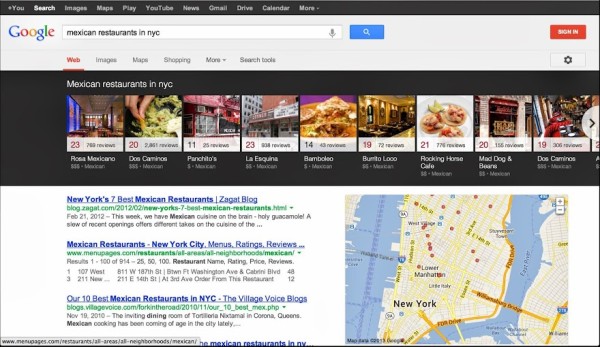
Google Officially Launches Knowledge Graph Carousel For Local Search

After reporting yesterday that the Google Knowledge Graph Carousel was showing up more frequently and for a wider variety of searches, a Google+ post today announced the official launch of Carousel for local search results.

According to the announcement, when a user searches for “restaurants, bars or other local places” from their desktop, they will get the horizontal Carousel display of images against a black background at the top of their SERP.
Caroursel Display
Users can scroll through more images by selecting the arrow on the right side of the carousel or zoom in on the map to pull results for a restricted area. By clicking on an image in the Carousel, users will see more location details, including overall review-based score, address and photos.
Google Knowledge Graph Carousel display
Google confirmed that Carousel results are rolling out today in English in the US, with more features and languages to come over time.

Wednesday, June 12, 2013

Google’s Matt Cutts: Same Ad To Organic Ratio As Google, You’re Safe From The Top-Heavy Alogrithm

At SMX Advanced tonight, Google’s head of search spam, Matt Cutts announced that if you have the same or less ads than Google does in their search results, then you are safe from their top heavy algorithm.

In short, if your ad to organic ratio is the same or less than what you see in Google’s search results, you are safe.

This came up durin the Ask The SEO session, where Matt Cutts was encouraged to come up on stage to answer some questions.

One question was around why does Google have so many ads in the organic result. Danny Sullivan joked, would Google penalize Google for top heavy algorithm? Matt responded seriously that even if the search results pages were indexed by Google, the algorithm that determines if a web page should be penalized or impacted negatively by the top heavy update, would not be triggered.

So you can use Google search results pages as a benchmark for not going overboard on the top heavy update.

Google Search Ranking Changes To Auto-Correct Your Mobile SEO Mistakes

Is your site not doing a good job for mobile visitors? Better get that fixed. Sites with mobile experience issues won’t rank as highly in Google’s mobile or smartphone search results, in the future.
Bad Mobile Site? Fewer Smartphone Search Rankings, For You

Google’s Yoshikiyo Kato and Pierre Far said about the change in a blog post today:

To improve the search experience for smartphone users and address their pain points, we plan to roll out several ranking changes in the near future that address sites that are misconfigured for smartphone users.

They followed by sharing two common mobile configuration mistakes of many and suggested these search ranking changes will help import the smartphone search experience for Google users.
Faulty Redirects

The first issue is called a “faulty” redirect, when a page listed in search may redirect all smartphone users to the same single mobile page, rather than to a mobile-optimized version of the page they’re after:

Credit: Google 

Smartphone-Only Error
The second common mistake is that smartphone users, when trying to access a web page listed in search, get an error and nothing listed.
 
Optimizing For Mobile
Google also says that if you properly configure your mobile friendly pages, it will “improve the mobile web, make your users happy, and allow searchers to experience and experience your content fully.”

Monday, June 3, 2013

Negative SEO Exists Confirms Google

For years, Google stood by the stance that there was little competitors could do to a website to negatively affect its search engine rankings. As natural links became more valuable and paid links were devalued or penalized, Google changed their stance slightly on the issue, but still maintained it wasn't a widespread issue, with Google's Matt Cutts admitting negative SEO isn't impossible, but it is difficult.

Then came the link disavow tool, which allows webmasters to disallow paid or low quality links and clean up their backlink profile, regardless of whether they or a competitor was responsible for pointing those backlinks at a website.

Now Google has changed their stance once again, simply saying that Google works hard to prevent competitors from utilizing negative SEO.

The change was noticed on the “Can Competitors harm ranking?” help page at Google Webmaster Tools.

When the page first went online, it simply stated “There’s nothing a competitor can do to harm your ranking or have your site removed from our index.” Last year, when negative SEO became a lot more prevalent, the wording was changed to “There's almost nothing a competitor can do to harm your ranking or have your site removed from our index.”

This week, webmasters noticed that the wording was changed once more, to “Google works hard to prevent other webmasters from being able to harm your ranking or have your site removed from our index.”

This is a clear admission that yes, negative SEO does exist and it can result in third parties being able to remove competing sites from the Google search index, or at least negatively impact their search rankings.

While changing the wording is a confirmation for many webmasters that Google is finally acknowledging the problem, it could also tip off negative SEO wars between competitors. Some webmasters might not have engaged in negative SEO for the simple reason that so many people insisted the problem was next to nonexistent, although those who have been impacted by it know otherwise. So some unscrupulous webmasters might think nothing of link bombing competitors with one of those “10,000 backlinks for $20” deals that are advertised everywhere.

That said, webmasters who might not follow SEO news closely, or who haven’t had their sites impacted by negative SEO, might never visit that page and see confirmation that negative SEO is a potential problem. The change to the page reflecting Google’s new stance on the issue was made very quietly, and seems limited to just that single page.

It is a step moving forward that Google is acknowledging that negative SEO is a real problem, but it is also positive that they are also acknowledging that they are looking at ways to combat the issue.

Tuesday, May 28, 2013

Google Facing U.S. Antitrust Probe Over Display Ad Sales

The U.S. Federal Trade Commission (FTC) is on the brink of launching a fresh antitrust probe into Google, over alleged misconduct over how it handles its display advertising business, Reuters reported.

An unnamed source confirmed the news to Reuters late last week, adding that the investigation is still in its early stages and that the FTC had not yet sent out civil investigative demands ordering Google to hand over data.

The probe will focus on the tools Google purchased from display ad company Doubleclick in 2007. The FTC reportedly began the investigation following demands from a number of unnamed competing display advertising companies, which accused Google of using its position in the display ads market to favor its own services.

The FTC has mounted antitrust probes against Google in the past. The FTC previously mounted an investigation into whether Google was using its search dominance to promote its own services more than those of its competitors. That antitrust probe ended in January, with Google only making a couple of minor changes.

Elsewhere on the antitrust front, Google's business in Canada is also about to face a formal inquiry from Canada's Competition Bureau, the Financial Post reported May 17. The agency has yet to reveal the scope of the investigation or asked for any documentation from Google.

Friday, May 3, 2013

Nearly 90% of Affluent Consumers Use Social Media [Study]

About 90 percent of mass affluent consumers use social media, according to a recent LinkedIn study.

The study, Influencing the Mass Affluent, classifies the mass affluent as consumers who have investable assets between $100,000 and $1 million. LinkedIn says that this group is active on social media and could prove a key market for financial institutions.

Of that 90 percent of the mass affluent that use social media, 44 percent engage with financial institutions on social media. LinkedIn reports that another 34 percent actively engage with financial institutions' content through social networking.

LinkedIn found that the mass affluent use social media primarily for professional reasons. The firm's study reported that one out of every two surveyed use social media to connect with other professionals. While one in three use social media to engage with professional content.

"Members on our platform have a value exchange and sense of trust with the platform. Because of that we have seen financial firms really adopt [LinkedIn] beyond just display advertising," said LinkedIn's lead executive in financial services, Jennifer Grazel.

According to the report, 36 percent of the mass affluent use social media for discovery and consideration. LinkedIn classifies discovery as learning about trends, products, and services, while the firm denotes that consideration as actively seeking advice on the things they've learned through social media.

LinkedIn classifies the mass affluent in three categories. The firm says that the mass affluent is either acquiring wealth, about to retire, or already retired. According to the research, financial institutions must tailor their social networking campaigns differently for each group.

"The key that struck a cord with us was the types of information mass affluents are getting through social media," Grazel saud.

For those accumulating wealth, relevant content is the most important factor for financial companies using social media. Those soon to retire find that timely updates are the most important factor when using social media. While retired consumers care more about strong customer support through social media.

Across all consumer types, information about new product information was found to be very important. Those surveyed said that they would like to see new product information posted on social media for both brokerage firms and credit/debit card companies.

LinkedIn also recommends that financial institutions must be mindful to drive conversation through social media. The company says that proper discussion on social media leads to greater influence and improved lead generation.

Matt Cutts Tells SEOs to Stop Worrying About Google Search Patents


If you're an avid SEO professional, you likely pay close attention to any new Google patents that are attached to the Search or Search Quality teams. It often gives insight about where the future of search could be headed, along with plenty of speculation about just how the patent could be applied and how it would affect webmasters.

Well, Google's Distinguished Engineer Matt Cutts brings up the topic of the many Google patents in his latest Google Webmaster Help video, which was an answer to the question about the latest SEO misconception he would like to put to rest.

“Just because a patent issues that has somebody’s name on it or someone who works at search quality or someone who works at Google, that doesn’t necessarily mean we are using that patent at that moment,” Cutts said in the video. “So sometimes you will see speculation Google had a patent where they mentioned using the length of time that a domain was registered. That doesn’t mean that we are necessarily doing that, it just means that mechanism is patented.”

He continues to describe another patent where Google looked at websites that were being updated after they did an update, which of course concerned webmasters that this could flag them, as they reacted to each update.

“Patents are a lot of interesting ideas, so you can see a lot of stuff mentioned in them, but don’t take it as an automatic golden truth that we are doing any particular thing mentioned in a patent,” he said.

Wednesday, April 24, 2013

Google Penalized Mozilla Only One Page Out of 22 Million

We announced yesterday that Google punished Mozilla over user generated content. Today, we tend to learn that it absolutely was a extremely, very little penalty that solely compact one page out of Mozilla’s ~22 million webpages.

Google’s head of search spam, Matt Cutts, additional to the Google thread explaining that this manual penalty was applied in a very granular manner. In fact, it solely compact one page on Mozilla’s name, blog.mozilla.org/respindola/about.

Besides that being an improbable range of spammy comments on one page, it's disconcerting to check however confused Mozilla’s webmaster was over Google’s penalty notification. Don’t get Maine wrong, i'm an enormous fan of Google obtaining additional elaborate in their Webmaster Tools penalty notifications. however as you'll be able to see from our coverage of the penalty and Mozilla’s questions about the penalty, it appeared that this was a trifle larger than simply impacting one page on this huge web site.

This is an identical scenario as once the BBC was punished, and it clothed to be a penalty on one page.

Friday, February 12, 2010

How To Get 2000 Links To Your Website

To rank your website in search engine results page, popular search engines like Google, Yahoo and MSN consider many factors, "Quality Backlinks" are one of the MOST IMPORTANT factor to be consider to rank any website HIGH in search engines. Our directory submission service ensure that each manual directory we submit with is relevant to your site; each directory is chosen based on pedigree and reliability. Any major search engine that actually catalogues and indexes a directory has to meet certain criteria. Our directory submission service ensures that each directory we submit to has been thoroughly researched and not blacklisted by any search engine.