Showing posts with label Organic SEO. Show all posts

Wednesday, June 12, 2013

Google’s Matt Cutts: Same Ad To Organic Ratio As Google, You’re Safe From The Top-Heavy Alogrithm

At SMX Advanced tonight, Google’s head of search spam, Matt Cutts announced that if you have the same or less ads than Google does in their search results, then you are safe from their top heavy algorithm.

In short, if your ad to organic ratio is the same or less than what you see in Google’s search results, you are safe.

This came up durin the Ask The SEO session, where Matt Cutts was encouraged to come up on stage to answer some questions.

One question was around why does Google have so many ads in the organic result. Danny Sullivan joked, would Google penalize Google for top heavy algorithm? Matt responded seriously that even if the search results pages were indexed by Google, the algorithm that determines if a web page should be penalized or impacted negatively by the top heavy update, would not be triggered.

So you can use Google search results pages as a benchmark for not going overboard on the top heavy update.

Google Search Ranking Changes To Auto-Correct Your Mobile SEO Mistakes

Is your site not doing a good job for mobile visitors? Better get that fixed. Sites with mobile experience issues won’t rank as highly in Google’s mobile or smartphone search results, in the future.
Bad Mobile Site? Fewer Smartphone Search Rankings, For You

Google’s Yoshikiyo Kato and Pierre Far said about the change in a blog post today:

To improve the search experience for smartphone users and address their pain points, we plan to roll out several ranking changes in the near future that address sites that are misconfigured for smartphone users.

They followed by sharing two common mobile configuration mistakes of many and suggested these search ranking changes will help import the smartphone search experience for Google users.
Faulty Redirects

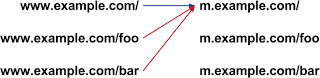
The first issue is called a “faulty” redirect, when a page listed in search may redirect all smartphone users to the same single mobile page, rather than to a mobile-optimized version of the page they’re after:

Credit: Google 

Smartphone-Only Error
The second common mistake is that smartphone users, when trying to access a web page listed in search, get an error and nothing listed.
 
Optimizing For Mobile
Google also says that if you properly configure your mobile friendly pages, it will “improve the mobile web, make your users happy, and allow searchers to experience and experience your content fully.”

Friday, May 3, 2013

Nearly 90% of Affluent Consumers Use Social Media [Study]

About 90 percent of mass affluent consumers use social media, according to a recent LinkedIn study.

The study, Influencing the Mass Affluent, classifies the mass affluent as consumers who have investable assets between $100,000 and $1 million. LinkedIn says that this group is active on social media and could prove a key market for financial institutions.

Of that 90 percent of the mass affluent that use social media, 44 percent engage with financial institutions on social media. LinkedIn reports that another 34 percent actively engage with financial institutions' content through social networking.

LinkedIn found that the mass affluent use social media primarily for professional reasons. The firm's study reported that one out of every two surveyed use social media to connect with other professionals. While one in three use social media to engage with professional content.

"Members on our platform have a value exchange and sense of trust with the platform. Because of that we have seen financial firms really adopt [LinkedIn] beyond just display advertising," said LinkedIn's lead executive in financial services, Jennifer Grazel.

According to the report, 36 percent of the mass affluent use social media for discovery and consideration. LinkedIn classifies discovery as learning about trends, products, and services, while the firm denotes that consideration as actively seeking advice on the things they've learned through social media.

LinkedIn classifies the mass affluent in three categories. The firm says that the mass affluent is either acquiring wealth, about to retire, or already retired. According to the research, financial institutions must tailor their social networking campaigns differently for each group.

"The key that struck a cord with us was the types of information mass affluents are getting through social media," Grazel saud.

For those accumulating wealth, relevant content is the most important factor for financial companies using social media. Those soon to retire find that timely updates are the most important factor when using social media. While retired consumers care more about strong customer support through social media.

Across all consumer types, information about new product information was found to be very important. Those surveyed said that they would like to see new product information posted on social media for both brokerage firms and credit/debit card companies.

LinkedIn also recommends that financial institutions must be mindful to drive conversation through social media. The company says that proper discussion on social media leads to greater influence and improved lead generation.

Friday, February 12, 2010

How To Get 2000 Links To Your Website

To rank your website in search engine results page, popular search engines like Google, Yahoo and MSN consider many factors, "Quality Backlinks" are one of the MOST IMPORTANT factor to be consider to rank any website HIGH in search engines. Our directory submission service ensure that each manual directory we submit with is relevant to your site; each directory is chosen based on pedigree and reliability. Any major search engine that actually catalogues and indexes a directory has to meet certain criteria. Our directory submission service ensures that each directory we submit to has been thoroughly researched and not blacklisted by any search engine.